Webflow Conf 2026: What It Means for Your Website (and Why We Build on Webflow)
.webp)

Webflow Conf 2026 (Boston and online, September 1 to 3) shipped a stack of updates that make client sites faster, easier to keep accessible, and readable by AI search engines. For Graceful Web Studio it means we can build and maintain better sites for service businesses and healthcare providers without adding cost or complexity on your end. The one caveat: the headline announcement, Source by Webflow, is still a research preview, so we are putting the features that shipped to work now and watching the rest.
Webflow Conf is Webflow's annual product event, and the 2026 edition set the platform's direction for the next year. It matters to your website because the studio that builds and maintains it builds on Webflow, so every capability Webflow adds is a capability we can pass to you. This year's theme was clear: faster sites, accessibility handled closer to the source, and content built to be found by AI, not just Google.
We watched the Builder Keynote live and took notes in real time. What follows is the short version, filtered for what actually changes your site.
We build every new site on Webflow because it gives service businesses and healthcare providers a fast, accessible, owner-friendly website without a developer on call for every small change. That is the whole promise, and Conf 2026 reinforced it. Webflow keeps investing in the two things our clients feel most: performance and content control. You get a site your team can update, that loads fast, and that we can keep in conformance with WCAG 2.2 Level AA over time.
Loyalty here is a practical choice, not a preference. We do not build or maintain WordPress, and we build new sites only in Webflow, because one platform done deeply beats five done shallowly. If you want the longer case, we wrote it up in why smart businesses are switching to Webflow.
We grouped our favorites into the three areas that change client work the most.
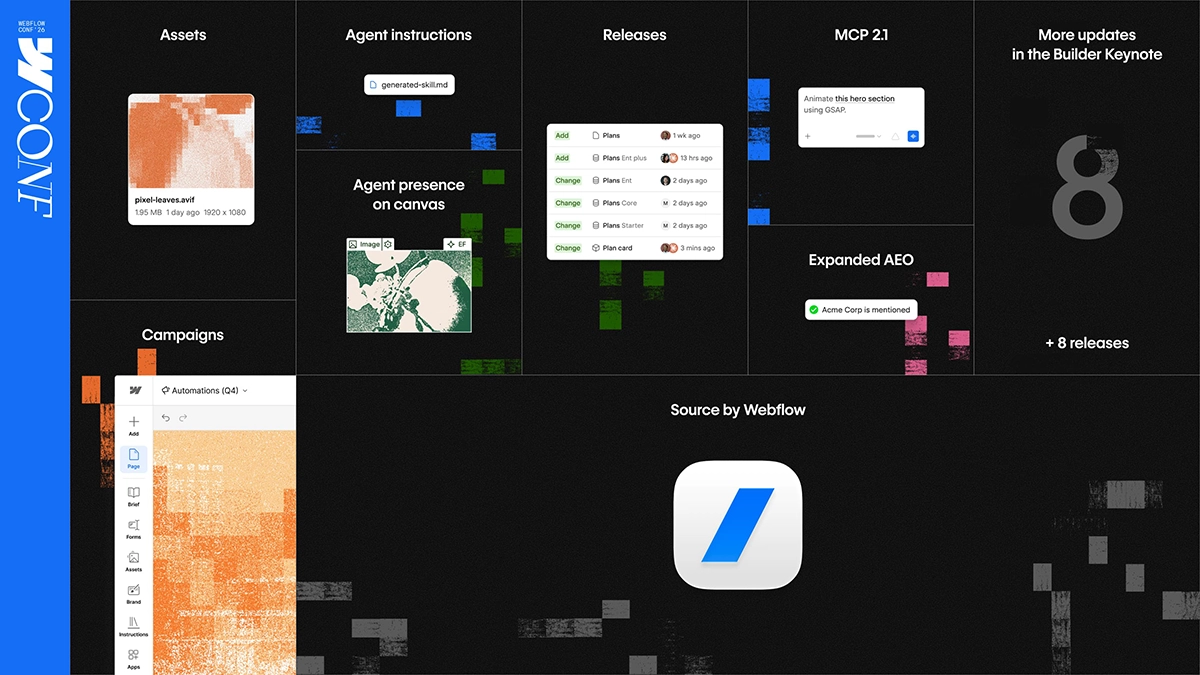
The updates your team touches shipped first, and most are available today. Components now embed directly inside rich-text fields, so a content editor can drop an interactive element into a blog post or resource page without touching code (this used to need a workaround). A new Popover element is built on the native web standard, which is a cleaner starting point for menus and tooltips. And the performance numbers are real: about 43% faster page rendering and about 80% faster publishing.
For a CMS-heavy site, a healthcare resource center or a service blog, rich-text components mean your content team ships richer pages on their own. That is a direct upgrade to what your monthly website support and maintenance plan can deliver.
Webflow AEO (Answer Engine Optimization) is the announcement we are most excited to put to work. It tracks how often AI tools mention your brand, shows which AI bots visit your site, and recommends fixes to metadata, schema, alt text, and broken links that you approve before they go live. Paired with new controls for llms.txt and fresh-content signals, it gives us a real way to influence whether ChatGPT and Perplexity cite you. This is the same SEO and AEO from day one work we already build in, now with better instrumentation. If you want the plain-English version, read how to appear in AI search results with AEO and GEO and our note on the llms.txt file as a scoring factor. It also feeds directly into our SEO service.
Source by Webflow is the big-picture announcement: an agentic platform where marketing teams and AI agents build and optimize sites together, with role-based workspaces and agents that watch performance. Webflow Campaigns (build a landing page and its matching ads together) sits inside it. The part we care about most is Agent Instructions, which lets us set rules that any AI agent must follow when it works on your site. That is how we keep accessibility conformance and brand standards intact even as agents do more of the mechanical work. Source itself is a limited research preview, so this is a direction to prepare for, not a switch to flip.
Webflow's own walkthrough shows what Source looks like in practice: a code-based system of truth for your brand, agents configured with specific access per teammate, a conversational assistant that builds and adjusts pages, and a dashboard that tracks conversion and funnel performance.
Watch Source by Webflow on YouTube
What's in the video. Source by Webflow is a platform for modern marketing teams and their AI agents to launch, optimize, and scale digital experiences. It opens on the Webflow logo, then a laptop display of app icons, framing a new way to build with Webflow. The Clarity Ops interface appears with navigation for Home, Inbox, Projects, and Workflows. The core message: the platform is where modern teams run the web, built on code, functioning as the source of truth for your brand system.
The platform manages brand identity, logos, and design layouts, handling the heavy lifting. Different agents, such as a section builder or a context agent, can be configured with specific access for team members. A conversational interface shows a user working with an AI agent named Maya, asking for help with tasks like building a dark-mode version of the homepage. The interface allows real-time adjustments and suggestions, giving control over visual design alongside code-based updates.
Workspaces are tailored to each teammate so they can collaborate. An activity feed shows the Source by Webflow agent making recommendations, such as adjusting pricing-page headers. A dashboard displays metrics, including conversion-rate growth and funnel performance, so teams can monitor impact. The video closes on the Source by Webflow branding and website.
The short answer: your site gets faster, stays accessible with less drift, gets found by AI, and changes go live more safely. Here is what we are doing with these updates, in order:
Most of this happens quietly inside your maintenance retainer and our accessibility remediation and consulting work. You do not have to learn any of it.
Not everything from Conf is ready for client sites, and we would rather tell you than oversell it. Source is a research preview, so we are learning it, not rebuilding your workflow around it. Accessible out of the box is a starting point we verify, not a guarantee we repeat; we still test with real assistive technology. Webflow AEO's analytics sit behind Team or Enterprise plans plus an add-on, so we will tell you honestly whether the numbers justify the cost for your site. And the new asset-adaptation tools from Webflow's Vidoso acquisition are not due until early 2027, so they are on our watch list, nothing more.
We treat staying current as part of the job, not an extra. If you like to follow along, the Webflow Updates page and the developer changelog are the primary sources, Webflow University covers the how-to, and the Webflow Conf hub holds the session replays. On our side, we keep a running learning tracker that scores every announcement by effort and maps it to client impact, so nothing useful slips through.
If you want your site to get these improvements without managing any of it, that is what our retainer is for. A monthly website support and maintenance plan means we apply the updates that help, skip the ones that do not, and keep your site fast, accessible, and found by search. New here, or thinking about a move off another platform? Start with a quick conversation. Request a free project quote or contact us with questions.
No. On a maintenance retainer, we review each Webflow update, apply the ones that help your site, and leave the rest. You keep working while we handle the platform.
They improve your chances, they do not guarantee it. Webflow AEO and llms.txt make your content easier for AI engines to find, understand, and cite, and they measure what is working. Getting cited still depends on strong, well-structured content and real authority, which is the work we do alongside the tooling.
No. Webflow confirmed at Conf that the Designer is not going away and is still getting investment. Source is a new agentic layer in limited preview, not a replacement for the tool your site is built in.
They start from web standards, which is a good foundation, but we verify every one against WCAG 2.2 Level AA and the APG patterns before using it on a client site. Accessibility conformance is tested on real assistive technology, not taken on a vendor's word.
Source is Webflow's agentic platform for marketing teams and their AI agents to build and optimize sites together. It is in limited research preview right now, so you do not need it today. We are learning it so we can advise you when it matters.
Written by Crystal Scott, founder of Graceful Web Studio. Crystal is a Certified Professional in Web Accessibility (CPWA), a Section 508 Trusted Tester, and a Certified Webflow Expert with over a decade of front-end experience.
Webflow design, SEO, and maintenance for Yakima Valley businesses, with published pricing and accessibility built into every build.
What accessibility annotation kits are, a checklist of what to annotate in Figma, and the kits and plugins we use at HHMI BioInteractive.
A realistic local SEO timeline, plus what works: Google Business Profile, an accessible site, and helpful content, with Yakima Valley client examples.
We would love to meet with you face-to-face. Whether virtually or for a coffee. Request a free project quote, and let’s find the right solution for you! We review your site, set-up a disocvery session and map out goals for a website that grows your business.